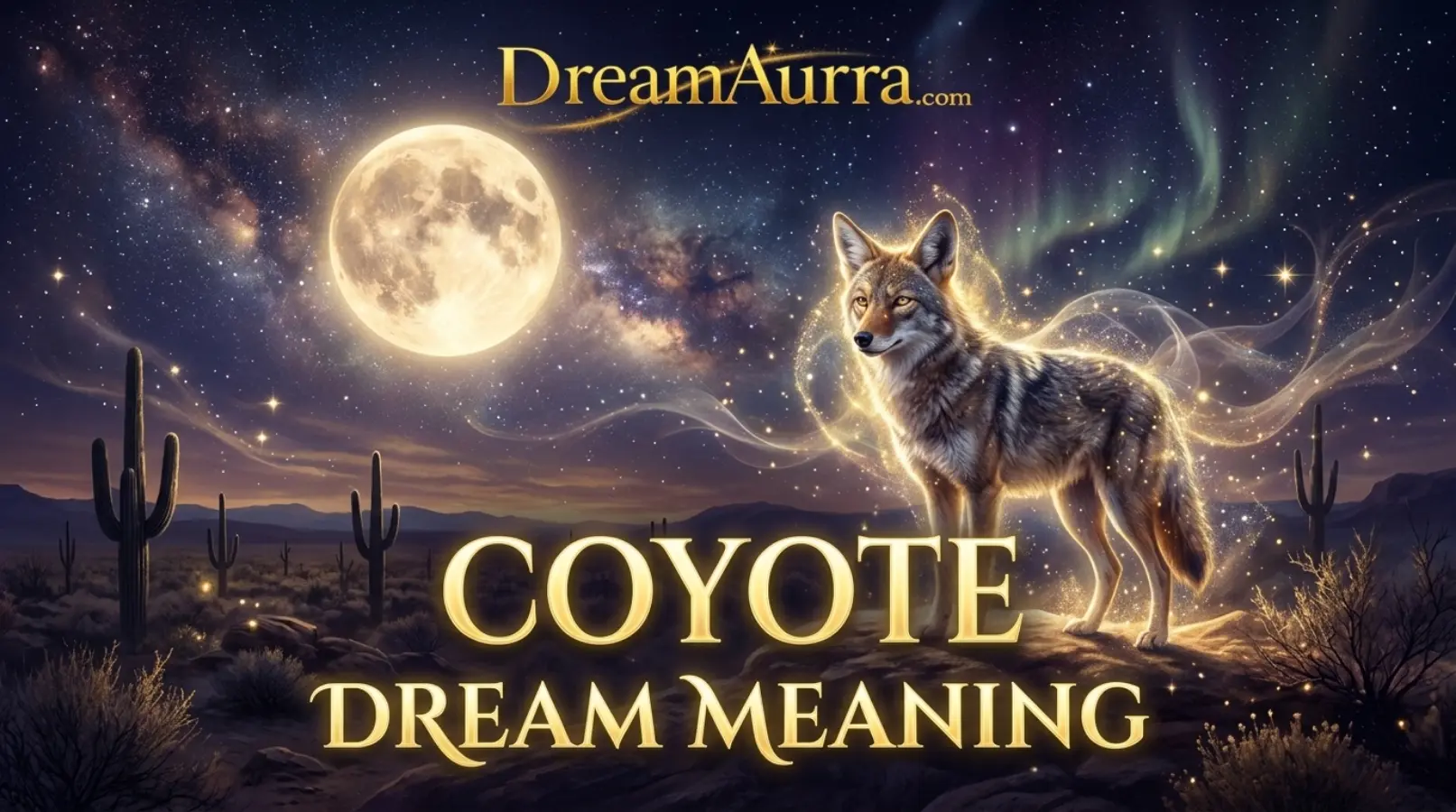
Coyote dream meaning often relates to adaptability, cleverness, survival, and the challenges you face in everyday life. Seeing a coyote in your dream may leave you feeling curious, frightened, or uncertain about its message. The meaning often depends on what the coyote was doing and how you felt during the dream.
Coyotes are known for their intelligence, resourcefulness, and ability to survive in changing environments. In dreams, these qualities may symbolize your ability to overcome obstacles and adjust to new situations. However, a threatening coyote may reflect stress, distrust, or concerns about someone around you.
Some people also explore coyote dreams through spiritual beliefs and cultural traditions. These interpretations can offer personal insight, but they are not proven predictions of the future.
Understanding your dream begins with your emotions, experiences, and the details you remember. This guide explores the spiritual, psychological, positive, and negative interpretations of coyote dreams.
⭐ Quick Answer
Coyote dream meaning often symbolizes adaptability, cleverness, independence, and survival. A peaceful coyote may represent confidence and resourcefulness, while an aggressive one may reflect fear, uncertainty, or trust issues. Your personal experiences and emotions help determine which interpretation feels most relevant.
🐺 What Does Coyote Dream Meaning Represent?
A coyote dream can have several possible meanings. Its symbolism often depends on the animal’s behavior and your reaction to it.
Common interpretations include:
- Adaptability: You may be learning to handle changes in your personal or professional life.
- Cleverness: The dream may highlight your ability to solve problems creatively.
- Independence: A coyote may represent your desire to make decisions without relying too heavily on others.
- Survival: You may be facing a difficult situation that requires patience and determination.
- Distrust: A threatening coyote could reflect concerns about honesty or hidden intentions.
- Freedom: Seeing a coyote in the wild may symbolize a desire for more space and independence.
- Uncertainty: An unpredictable coyote may represent a situation you do not fully understand.
A coyote does not automatically represent danger or betrayal. Sometimes, it simply reflects something you recently saw, experienced, or thought about.
Consider the entire dream rather than focusing on the animal alone.
✨ Spiritual Meaning of Coyote Dream Meaning
Spiritually, a coyote dream may encourage you to examine your choices, trust your judgment, and remain flexible during change.
Different spiritual traditions interpret animals in different ways. There is no single spiritual meaning that applies to everyone.
1. A Symbol of Adaptability
A coyote can represent the ability to adjust when life becomes unpredictable.
If you are facing a new job, relationship change, or personal challenge, the dream may reflect your need to remain flexible. It can encourage you to explore different solutions instead of giving up.
2. A Reminder to Trust Your Judgment
A coyote dream may invite you to pay closer attention to your decisions.
You might be dealing with confusing advice or conflicting opinions. The dream could reflect your desire to understand a situation before taking action.
This does not mean the dream reveals hidden truths. Instead, use it as an opportunity to think carefully about your circumstances.
3. Inner Transformation
Seeing a coyote may symbolize a period of personal growth.
Perhaps you are becoming more independent, learning from mistakes, or developing confidence. The dream may reflect your changing understanding of yourself.
4. Awareness of Your Surroundings
An alert or watchful coyote may symbolize the need to pay attention to your environment.
You might benefit from setting clearer boundaries or thinking carefully before making important decisions. However, the dream alone cannot establish that someone is working against you.
5. The Trickster Symbol
In some cultural and storytelling traditions, the coyote appears as a trickster figure. Trickster characters may represent cleverness, humor, unpredictability, or lessons learned through mistakes.
If this symbolism resonates with you, the dream may encourage you to question assumptions and approach a problem from another perspective.
Coyote stories vary across Indigenous nations and communities. Their meanings should not be treated as one universal Native American belief.
🧠 Psychological Interpretation of Coyote Dreams
From a psychological perspective, coyote dreams may reflect your emotions, recent experiences, or the challenges occupying your thoughts.
Dreams do not have scientifically established universal meanings. Their interpretation is best approached as a personal reflection rather than a diagnosis or prediction.
Stress and Uncertainty
If the coyote chases or attacks you, the dream may reflect pressure in your waking life.
You might feel overwhelmed by responsibilities, deadlines, conflict, or a difficult decision. The dream may provide a way to explore feelings you have not fully addressed.
Anxiety About Trust
An aggressive or unpredictable coyote may connect with concerns about trust.
Perhaps you are uncertain about someone’s intentions or uncomfortable with a situation. However, the dream is not evidence that a particular person is dishonest.
Look for real-world information before drawing conclusions about other people.
Desire for Independence
A lone coyote may reflect your wish to handle problems independently.
You might want more freedom, personal space, or control over your decisions. Alternatively, the dream may highlight the difficulty of managing everything alone.
Confidence and Resourcefulness
A calm coyote that moves confidently through its environment may reflect your ability to adapt.
You may be learning to solve problems, respond to change, or trust your skills. The dream can serve as a reminder of strengths you already possess.
Processing Recent Experiences
Sometimes, dreams incorporate animals, stories, videos, or conversations encountered during the day.
If you recently saw a coyote or watched content about one, your dream may simply reflect that experience.
🌟 Positive Meanings of Coyote Dreams
Not every coyote dream carries a frightening message. Some scenarios may reflect confidence, independence, and personal growth.
Possible positive interpretations include:
- Resourcefulness: You can find creative ways to approach difficult problems.
- Personal freedom: You may be ready to make more independent choices.
- Resilience: You are learning to recover from setbacks.
- Awareness: You are becoming more thoughtful about your surroundings.
- Confidence: You may be recognizing your ability to handle uncertainty.
- Adaptation: You are learning to accept change instead of resisting it.
- Personal growth: You may be developing new skills and perspectives.
For example, dreaming of a coyote walking peacefully beside you may reflect a growing sense of confidence.
The important question is whether the dream’s emotions connect with something positive happening in your life.
⚠️ Negative Meanings of Coyote Dreams
A frightening coyote dream may reflect worries or unresolved emotions. However, it does not guarantee that something bad will happen.
Possible negative interpretations include:
- Fear: You may feel threatened by an uncertain situation.
- Distrust: You might be struggling to decide whom to trust.
- Feeling trapped: A chasing coyote may represent a problem you want to avoid.
- Conflict: An attacking coyote may reflect tension with another person.
- Lack of control: A pack of coyotes may symbolize several pressures happening at once.
- Emotional exhaustion: A persistent threat in a dream may reflect ongoing stress.
These interpretations are possibilities, not fixed rules.
If a coyote dream frightens you, focus on what you can control in your waking life. You do not need to treat the dream as a warning of danger.
🐾 Common Coyote Dream Scenarios and Their Meanings
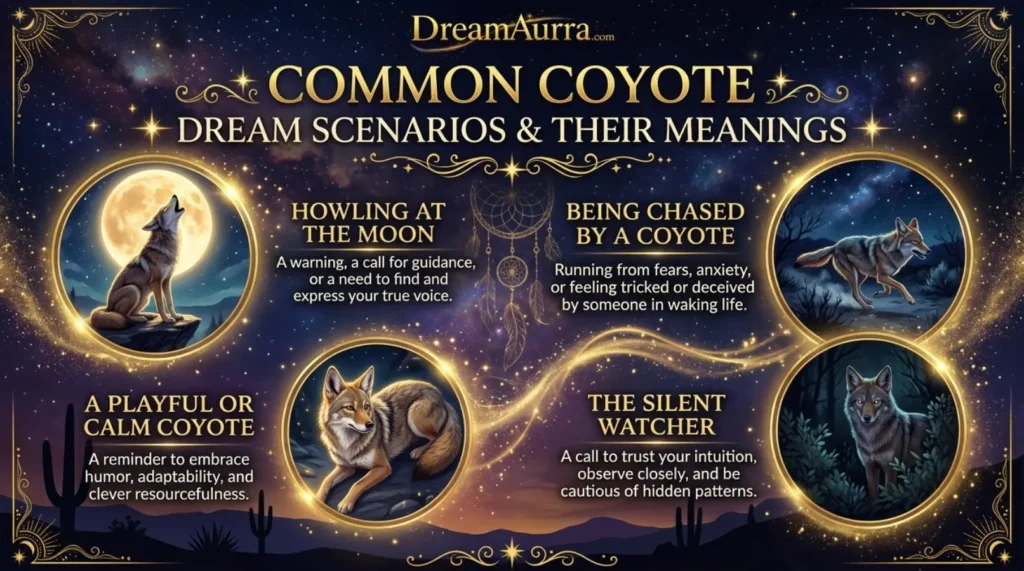
The details of your dream can help you explore its personal meaning. Below are common scenarios and possible interpretations.
1. Dreaming of a Coyote Chasing You
A coyote chasing you may symbolize pressure, fear, or a problem you are trying to avoid.
You might be postponing a difficult conversation or feeling overwhelmed by responsibilities. The dream may encourage you to identify what is causing stress.
Ask yourself what you were running away from emotionally.
2. Dreaming of a Coyote Attacking You
A coyote attack may reflect feelings of vulnerability, conflict, or uncertainty.
Perhaps a situation feels difficult to manage, or you are worried about losing control. The dream does not prove that someone intends to hurt you.
Consider whether a recent disagreement or stressful experience could explain the dream.
3. Dreaming of Killing a Coyote
Killing a coyote in a dream may symbolize confronting a challenge or trying to regain control.
It could reflect your determination to overcome an obstacle. It might also represent frustration or a desire to end a difficult situation.
Your emotions matter. Relief may suggest a sense of resolution, while guilt may point toward an internal conflict.
4. Dreaming of a Friendly Coyote
A friendly coyote may represent comfort with change, confidence, or curiosity.
You may be discovering new ways to solve problems or becoming more comfortable with your independence.
If you felt peaceful around the animal, consider which parts of your life currently feel stable or encouraging.
5. Dreaming of a Black Coyote
A black coyote may symbolize uncertainty, fear, or the parts of a situation you do not fully understand.
In some personal interpretations, black represents mystery or the unknown. However, black does not automatically mean evil, bad luck, or spiritual danger.
Think about whether the animal’s appearance made you feel afraid, curious, or calm.
6. Dreaming of a White Coyote
A white coyote may symbolize clarity, peace, hope, or a fresh perspective.
You might be looking for a calmer way to handle a difficult situation. Alternatively, the unusual color may simply reflect your imagination.
There is no universally accepted spiritual meaning for a white coyote.
7. Dreaming of a Pack of Coyotes
A pack of coyotes may represent teamwork, social pressure, or several challenges occurring together.
If the pack was peaceful, the dream might connect with cooperation or a sense of belonging. If the animals surrounded you, it could reflect feeling overwhelmed.
Consider whether family, work, or social expectations are affecting you.
8. Dreaming of a Coyote Howling
A howling coyote may symbolize communication, loneliness, or a desire to be heard.
The dream could reflect feelings you have not expressed or a need to connect with others. Its meaning depends on whether the sound felt comforting, disturbing, or familiar.
9. Dreaming of a Coyote in Your House
A coyote inside your home may symbolize personal boundaries or concerns affecting your private life.
You might be dealing with family tension, unexpected changes, or difficulty finding peace at home.
Consider whether something has recently disrupted your comfort or sense of security.
10. Dreaming of a Coyote Biting You
A coyote bite may represent emotional hurt, conflict, or a situation that feels difficult to ignore.
If the bite frightened you, the dream may connect with feelings of vulnerability. If you fought back, it could reflect your desire to defend yourself.
It is not proof of betrayal or a prediction of physical harm.
11. Dreaming of a Coyote Watching You
A coyote watching from a distance may symbolize awareness, caution, or uncertainty.
You might be observing a situation before deciding what to do. Alternatively, the dream could reflect feeling judged or watched by others.
Ask yourself whether you feel comfortable with the attention you are receiving in real life.
12. Dreaming of a Baby Coyote
A baby coyote may symbolize curiosity, developing confidence, or a new responsibility.
It could connect with a new project, relationship, or skill that needs time to grow. If the baby animal appeared helpless, you may be thinking about protection or care.
The dream’s emotional tone can help you understand which interpretation fits.
13. Dreaming of a Dead Coyote
A dead coyote may symbolize an ending, a change in perspective, or the loss of a familiar way of coping.
You might be leaving an old habit behind or adjusting to a situation that has changed. The dream could also reflect sadness or concern.
It does not necessarily predict loss or misfortune.
14. Dreaming of a Coyote Running Away
A coyote running away may represent reduced tension, growing independence, or a problem becoming less central to your attention.
If you felt relieved, the dream might connect with a recent sense of progress. If you felt disappointed, it could reflect uncertainty about an opportunity.
Consider what the departing animal represented to you personally.
📖 Biblical / Islamic / Cultural Meaning of Coyote Dreams
Religious and cultural interpretations require care because the coyote does not carry the same symbolism in every tradition.
Biblical Meaning of a Coyote Dream
The Bible does not provide a specific, established interpretation for dreaming about a coyote.
Some readers may associate a threatening wild animal with danger, wilderness, or the need for caution. However, these are personal comparisons rather than a direct biblical interpretation of coyotes.
A coyote dream should not automatically be understood as a message from God or a prediction of future events.
If you approach dreams through Christianity, you may reflect on your emotions, pray for wisdom if that fits your beliefs, and consider your circumstances calmly.
Islamic Meaning of a Coyote Dream
Islamic dream interpretation includes a long history of scholarly discussion, but not every animal has one fixed meaning.
There is no universally established Islamic interpretation that makes a coyote dream a definite sign of an enemy, magic, or future harm.
Muslims may understand dreams within their broader religious beliefs and personal circumstances. A dream alone should not be used to accuse someone or make a serious decision.
If a dream disturbs you, you may follow the guidance you trust within your Islamic tradition and seek advice from a knowledgeable, balanced religious teacher.
Native American and Other Cultural Interpretations
Coyotes have important roles in stories and traditions among various Indigenous peoples of North America.
In some traditions, coyote figures appear as tricksters, teachers, creators, or characters whose actions reveal lessons about human behavior. These roles differ between communities and stories.
It would be inaccurate to claim that all Indigenous peoples interpret coyote dreams in the same way.
In contemporary popular spirituality, coyotes are sometimes associated with adaptability, cleverness, and unexpected change. These interpretations may be meaningful to some people, but they should not be presented as universal cultural facts.
🤔 Is Coyote Dream Meaning Good or Bad?
Coyote dream meaning can feel positive, negative, or neutral depending on the situation.
| Dream scenario | Possible interpretation |
| Friendly coyote | Confidence or adaptability |
| Coyote chasing you | Stress or avoidance |
| Coyote attacking you | Vulnerability or conflict |
| Coyote walking peacefully | Independence or calm |
| Pack of coyotes | Social pressure or cooperation |
| White coyote | Hope or a fresh perspective |
| Coyote running away | Relief or changing priorities |
| Coyote watching you | Caution or self-awareness |
A peaceful dream may reflect confidence, while a frightening dream may highlight stress or uncertainty.
Neither experience automatically predicts the future.
To understand your dream, consider three questions:
- What emotion did you feel most strongly?
- What is currently changing in your life?
- Does the coyote remind you of a person, problem, or personal quality?
Your answers may reveal a more useful interpretation than a general dream dictionary.
🌿 What Should You Do After a Coyote Dream?
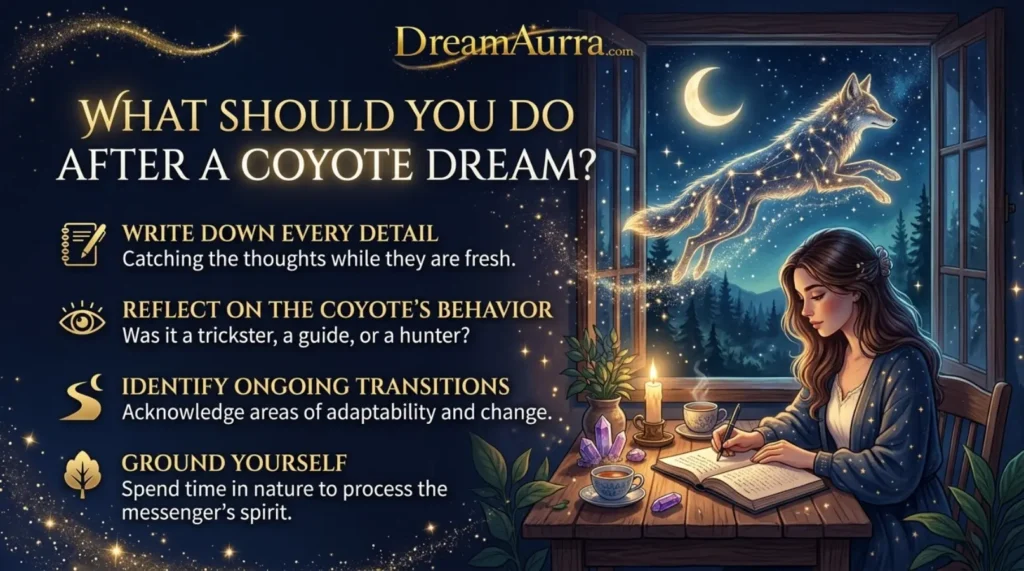
A vivid coyote dream can stay in your mind long after you wake up. You can use the experience as an opportunity for reflection without becoming afraid.
1. Reflect on Your Emotions
Remember whether you felt frightened, confident, curious, or peaceful.
Emotions can provide clues about which waking-life experiences might relate to the dream.
2. Write Down the Details
Keep a dream journal beside your bed or use a notes app.
Record the coyote’s appearance, behavior, surroundings, and your feelings. Writing these details down may help you notice recurring themes.
3. Examine Your Current Challenges
Ask whether you are dealing with change, uncertainty, relationship tension, or a difficult decision.
You do not need to connect every dream with a specific problem. Simply consider whether any connection feels reasonable.
4. Avoid Fear-Based Interpretations
Do not assume a coyote dream predicts betrayal, illness, death, or bad luck.
Dreams can be vivid and emotionally powerful without being supernatural warnings.
5. Focus on Practical Action
If the dream reminds you of a real concern, address that concern directly.
You might set healthier boundaries, plan for a change, or have an honest conversation. Base important decisions on real evidence rather than dream symbolism alone.
6. Give Yourself Time to Feel Calm
If the dream frightened you, take a few slow breaths and remind yourself that you are awake.
A disturbing dream does not mean you are in immediate danger. If recurring nightmares regularly disrupt your sleep or daily life, consider discussing them with a qualified health professional.
🚫 Common Mistakes When Interpreting Coyote Dreams
Dream symbolism can be useful for reflection, but certain mistakes may create unnecessary fear.
1. Taking Every Dream Literally
A coyote attack in a dream does not mean an actual attack will occur.
Dreams can combine memories, imagination, emotions, and everyday concerns.
2. Assuming the Dream Predicts the Future
There is no reliable evidence that a coyote dream predicts betrayal, financial loss, or other specific events.
Treat interpretations as possibilities rather than facts.
3. Believing Every Coyote Represents an Enemy
Coyotes can symbolize many things, including adaptability, freedom, and independence.
Automatically associating them with dishonest people may create suspicion without evidence.
4. Ignoring Your Emotional Response
The same animal can produce different feelings in different people.
A peaceful coyote may comfort one dreamer but frighten another. Your reaction is an important part of personal interpretation.
5. Treating Cultural Interpretations as Universal
Religious and Indigenous traditions contain diverse teachings about animals and dreams.
Avoid applying one interpretation to every person or community.
6. Overlooking Everyday Experiences
A recent wildlife encounter, video, conversation, or stressful day may influence your dream.
Sometimes, an ordinary explanation is more relevant than a spiritual one.
🔍 Final Verdict: What Does a Coyote Dream Mean?
Coyote dream meaning often connects with adaptability, cleverness, independence, survival, and uncertainty.
A peaceful coyote may reflect confidence or flexibility. A chasing or attacking coyote may relate to stress, conflict, or feeling vulnerable. Other scenarios may carry different meanings based on your emotions and experiences.
Spiritually, some people view the coyote as a symbol of change, awareness, or resourcefulness. Psychologically, the dream may reflect concerns and feelings that occupy your mind.
However, no single interpretation applies to everyone. A coyote dream does not automatically predict danger or reveal another person’s intentions.
The most helpful approach is to consider the dream calmly and connect it with your actual life. Use its symbolism to understand yourself, not to create unnecessary fear.
❤️ Conclusion
A coyote dream may invite you to think about your independence, adaptability, and emotional well-being. Whether the animal appeared friendly or frightening, your dream does not have to become a source of worry.
Pay attention to your feelings and the situations you are experiencing. You may discover a useful reminder about confidence, boundaries, or handling change.
Remember that dreams are personal experiences, not guaranteed predictions. You can explore their possible meanings while staying grounded in reality and trusting your own judgment.
❓ Frequently Asked Questions
1. Is dreaming about a coyote good or bad?
Dreaming about a coyote can have positive, negative, or neutral meanings. A friendly coyote may symbolize adaptability, while an aggressive one may reflect stress or uncertainty. The dream’s details and your emotions help shape its personal meaning.
2. Why do I keep dreaming about coyotes?
Recurring coyote dreams may relate to ongoing stress, repeated thoughts, recent experiences, or a situation that remains unresolved. They do not necessarily indicate a supernatural warning. Recording your dreams may help you identify recurring emotions or themes.
3. What does a coyote dream mean spiritually?
Spiritually, some people associate coyotes with cleverness, adaptability, independence, and unexpected change. These interpretations vary across personal beliefs and cultural traditions. There is no single spiritual meaning that applies to everyone.
4. Is a coyote dream a warning?
A coyote dream is not reliable evidence of future danger or betrayal. If the dream feels threatening, consider whether it reflects a real concern or recent stressful experience. Make decisions based on facts rather than fear.
5. Does dreaming about a coyote mean change is coming?
A coyote dream may symbolize your thoughts about change, independence, or uncertainty. However, it cannot reliably predict that a specific change will happen. Consider whether you are already experiencing a transition or preparing for something new.

Eithne White is a dream meaning writer who explains common dreams, spiritual symbols, and subconscious signs in simple language. She creates easy-to-understand guides about dream interpretations, hidden meanings, and emotional symbolism. Her writing helps readers explore the meaning behind dreams in a calm and beginner-friendly way. At Dreamaurra, Eithne White shares insightful content about dreams, spirituality, and symbolic meanings.