Rape dreams meaning can feel confusing, frightening, or deeply upsetting, especially when the experience feels real. If you have experienced this dream, you may wonder whether it reveals something about your emotions, relationships, or spiritual life. You might also worry that it predicts something bad.
However, a rape dream does not automatically mean that you want the experience or that it will happen in real life. Dreams can reflect fear, stress, vulnerability, past experiences, or concerns about personal boundaries. Sometimes, they contain disturbing images without having one clear meaning.
The emotions you feel during the dream can offer useful clues. Feeling trapped may reflect helplessness, while escaping may symbolize a desire for safety and control. Your personal experiences also matter when interpreting this dream.
This guide explores the spiritual, psychological, and cultural meanings of rape dreams. It also offers gentle advice for understanding your emotions without unnecessary fear or shame.
⭐ Quick Answer
Rape dreams meaning often relates to fear, vulnerability, powerlessness, violated boundaries, or emotional distress. Such dreams do not predict future events or reveal hidden desires. Their meaning depends on your personal experiences, feelings, and circumstances.
What Does Rape Dreams Meaning Reveal?
Rape dreams can symbolize situations where you feel powerless, pressured, unsafe, or unable to express your wishes. However, there is no single interpretation that applies to everyone.
Here are some possible meanings:
- Loss of control: You may feel that someone else controls an important part of your life.
- Personal boundaries: The dream may reflect discomfort with someone ignoring your needs or limits.
- Emotional vulnerability: You might feel exposed, judged, or unable to protect yourself.
- Fear and anxiety: Current stress can influence the disturbing images that appear in dreams.
- Past experiences: Previous trauma or frightening experiences may sometimes influence dream content.
- Relationship pressure: You may feel pressured to please someone or agree with something you do not want.
- Need for safety: The dream may highlight your desire for security, trust, and emotional support.
These interpretations are possibilities, not established facts about your subconscious mind. A disturbing dream does not prove that someone is harming you or that a particular person has bad intentions.
🌙 Spiritual Meaning of Rape Dreams
The spiritual meaning of rape dreams can involve personal boundaries, emotional healing, inner strength, and the need to feel safe. Spiritual interpretations vary across individuals and traditions.
It is important to remember that no reliable evidence shows these dreams predict supernatural events.
1. A Reminder to Protect Your Boundaries
Some people interpret this dream as a reminder to examine their personal boundaries.
You might be giving too much time to others or feeling pressured to meet their expectations. The dream could encourage you to consider whether your relationships allow you to feel respected.
2. A Symbol of Inner Healing
If the dream brings up strong emotions, you may view it as an opportunity to care for yourself.
Healing does not require finding a hidden message in every disturbing image. Sometimes, acknowledging your feelings is enough.
3. A Desire for Emotional Peace
A frightening dream may encourage reflection on your emotional well-being.
Consider whether you have been experiencing conflict, uncertainty, or a lack of support. Gentle reflection, prayer, meditation, or journaling may help you feel more grounded.
4. Reclaiming Your Personal Power
Escaping or resisting an attacker in a dream may feel connected to strength and independence.
You might interpret this image as a personal reminder that your choices, consent, and boundaries matter. However, the dream does not prove that you are facing a spiritual battle.
🧠 Psychological Interpretation of Rape Dreams
From a psychological perspective, rape dreams may relate to fear, stress, vulnerability, or experiences that feel threatening. Dreams can combine memories, emotions, and imagined situations in unexpected ways.
A dream alone cannot establish a psychological diagnosis or reveal a specific hidden memory.
Stress and Anxiety
High stress can affect sleep and dream content. Work pressure, family conflict, financial concerns, or relationship difficulties may contribute to disturbing dreams.
For example, someone who feels trapped in a difficult situation may dream about being unable to escape. This does not mean the situation is equivalent to sexual violence.
Feeling Powerless
You may feel that your opinions do not matter or that you have little control over an important decision.
The dream may reflect these feelings through an extreme or frightening scenario. Still, this is only one possible interpretation.
Past Trauma or Difficult Experiences
People who have experienced sexual assault or other trauma may sometimes have distressing dreams related to fear, helplessness, or safety.
However, people without such experiences can also have rape dreams. Having this dream does not prove that you experienced hidden or forgotten abuse.
If the dream repeatedly causes distress, a qualified mental health professional can help you explore it safely.
Relationship Concerns
Sometimes, a disturbing dream may occur when trust or personal boundaries feel uncertain.
You might be uncomfortable with someone’s behavior or struggling to communicate your needs. The dream itself cannot confirm that a relationship is harmful, but your waking experiences deserve attention.
Random or Unusual Dream Content
Not every dream has a deep psychological meaning.
Dreams can contain disturbing scenes that do not match your beliefs, desires, or real-life intentions. You do not need to interpret every detail as a message about yourself.
🌿 Positive Meanings of Rape Dreams
Although the dream itself can be upsetting, reflecting on it may help you recognize emotional needs or personal boundaries.
Possible constructive interpretations include:
- Greater self-awareness: You begin noticing feelings you have been ignoring.
- Stronger boundaries: You recognize the importance of saying no when something feels wrong.
- Seeking support: You realize that sharing your worries with someone trustworthy may help.
- Emotional reflection: You identify situations that leave you feeling pressured or powerless.
- Personal empowerment: You focus on choices that support your safety and independence.
- A step toward healing: If the dream connects with past distress, you may decide to seek appropriate support.
These are opportunities for reflection, not guaranteed outcomes or predictions.
⚠️ Negative Meanings of Rape Dreams
Rape dreams can sometimes reflect difficult emotions or disrupted sleep. They may feel especially distressing when they happen repeatedly.
Possible concerns include:
- Feeling unsafe: You may be worried about your surroundings or a particular situation.
- Emotional overwhelm: You might be dealing with more stress than you can comfortably manage.
- Unresolved distress: Difficult experiences may still affect your sense of security.
- Fear of losing control: You may feel unable to influence an important situation.
- Sleep disruption: Repeated disturbing dreams may make it harder to rest peacefully.
- Lingering fear: The dream may leave you anxious even after you wake up.
These possibilities do not mean that something bad will happen. If the dream affects your daily life, you deserve support rather than fear-based interpretations.
🔎 Common Rape Dream Scenarios and Their Meanings
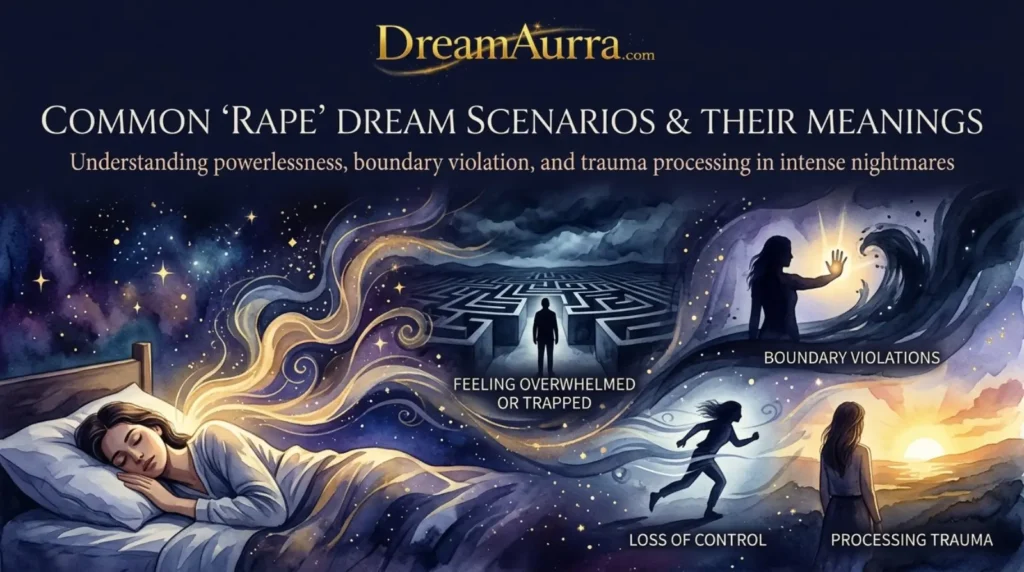
Different dream scenarios may bring up different emotions. Your feelings and personal circumstances are more important than any fixed dream dictionary definition.
1. Dreaming About Being Raped by a Stranger
This dream may reflect a general fear of vulnerability, uncertainty, or losing control.
A stranger in a dream does not necessarily represent an actual person who intends to harm you. Consider whether anything in your current life makes you feel unsafe or overwhelmed.
2. Dreaming About Being Raped by Someone You Know
This scenario can be especially disturbing because the person may be someone you trust.
It does not automatically mean that the person is dangerous or secretly wants to hurt you. The dream may involve complicated emotions, concerns about trust, or unrelated fears.
If the person has actually crossed your boundaries or threatened you, pay attention to those real-life behaviors rather than relying on the dream alone.
3. Dreaming About Being Raped by a Partner
This dream may bring up questions about trust, consent, intimacy, or control.
Sometimes, it reflects anxiety rather than a problem in the relationship. In other situations, it may occur alongside real concerns about pressure or ignored boundaries.
Consent matters in every relationship. If a partner forces sexual activity or ignores your refusal, that behavior deserves serious attention regardless of your dreams.
4. Dreaming About Escaping a Rape Attempt
Escaping in a dream may feel connected to self-protection, independence, or the desire to regain control.
You might be processing a difficult situation or imagining a way to protect yourself. However, escaping does not guarantee that a current problem will resolve itself.
5. Dreaming About Being Unable to Move or Call for Help
This scenario may reflect helplessness, fear, or frustration.
Sometimes, people experience an inability to move or speak while falling asleep or waking up. If this happens during the transition between sleep and wakefulness, it may be related to sleep paralysis.
Not every dream about being unable to move is sleep paralysis.
6. Dreaming About Being Raped and Feeling Guilty
Guilt or shame after a disturbing dream can be painful.
Remember that dream content is not a moral choice. You are not responsible for involuntary images that appear while you sleep.
Try to identify the emotion without blaming yourself for the dream.
7. Dreaming About Being Raped and Fighting Back
Fighting back may symbolize resistance, anger, or a desire to protect your boundaries.
It can also simply be part of the dream’s frightening storyline. You do not need to prove your strength through a particular dream response.
8. Dreaming About Being Raped Repeatedly
Recurring rape dreams can be exhausting and upsetting.
Repeated dreams may be associated with stress, trauma, anxiety, or disrupted sleep, but they do not have one universal cause.
If these dreams interfere with your sleep or daily activities, consider speaking with a qualified mental health professional.
9. Dreaming About Witnessing Someone Being Raped
Witnessing sexual violence in a dream may bring up feelings of fear, helplessness, or concern for another person.
It might relate to worries about protecting someone or reacting to distressing information. It does not predict that someone will experience assault.
10. Dreaming About Being Raped and Waking Up Crying
Waking up crying can happen when a dream produces intense emotions.
Your body may still feel frightened after you recognize that the experience was a dream. Take a moment to orient yourself to your surroundings and allow your emotions to settle.
If the distress continues, talking to someone you trust may help.
📖 Biblical, Islamic, and Cultural Meaning of Rape Dreams
Religious and cultural interpretations of disturbing dreams differ widely. It is important to approach them with care and avoid claiming that every dream has a definite spiritual explanation.
Biblical Meaning of Rape Dreams
The Bible discusses sexual violence, injustice, dignity, and the responsibility to protect vulnerable people.
However, it does not provide one universally accepted interpretation for every modern dream involving rape.
Some Christians may reflect on such a dream through themes of safety, justice, personal boundaries, or emotional healing. Others may see it as a distressing dream without a special spiritual message.
A rape dream does not automatically mean that God is punishing you or warning you about a specific person.
Islamic Meaning of Rape Dreams
In Islam, dreams are approached within a broader religious tradition, and not every dream is treated as a prediction or a message requiring interpretation.
A frightening dream should not automatically be understood as a sign of future harm, spiritual punishment, or personal wrongdoing.
Some Muslims find comfort in seeking refuge in Allah, praying, and following familiar Islamic guidance concerning unpleasant dreams. For specific religious questions, consult a trusted and knowledgeable Islamic scholar.
Importantly, having an involuntary dream does not make you morally responsible for its content.
Cultural Meaning of Rape Dreams
Across cultures, dreams involving threats or violence may be interpreted through ideas about fear, power, relationships, or spiritual concerns.
These interpretations vary and are not scientifically established rules.
Avoid anyone who uses your dream to frighten you, blame you, or make unsupported claims about curses, betrayal, or future assault.
❓ Is Rape Dreams Meaning Good or Bad?
Rape dreams are usually distressing, but the dream itself is not proof of a good or bad future event.
Its emotional significance depends on your circumstances and how you feel about the experience.
| Dream experience | Possible interpretation |
| Feeling trapped | Stress or a sense of powerlessness |
| Escaping an attacker | A desire for safety or control |
| Recognizing someone familiar | Concerns about trust or unrelated emotional associations |
| Repeated frightening dreams | Ongoing distress, stress, or sleep disruption |
| Waking up anxious | A strong emotional response to the dream |
| Feeling confused afterward | Uncertainty about the dream’s meaning |
These are possible associations, not fixed interpretations.
The most important point is that a rape dream does not mean you want sexual violence, deserve harm, or will experience assault.
If your dream reminds you of actual abuse or a real safety concern, you can seek help without needing to interpret the dream first.
💡 What Should You Do After a Rape Dream?
Waking up from a frightening dream can leave you unsettled. A few gentle steps may help you feel safer and understand your emotions.
1. Remind Yourself That You Are Awake
Look around your room and notice familiar objects.
Take slow, comfortable breaths and remind yourself that the dream has ended. If you are currently unsafe, prioritize getting to a safe place.
2. Identify Your Emotions
Ask yourself a few simple questions:
- Did I feel frightened, trapped, angry, or helpless?
- Have I experienced unusual stress recently?
- Is there a real situation making me uncomfortable?
- What would help me feel safer or more supported?
You do not need to answer every question.
3. Keep a Dream Journal
Write down the dream if doing so feels comfortable.
Record the main events, your emotions, and any recent stressors. Over time, you may notice connections between your sleep and daily experiences.
If writing about the dream makes you feel worse, you can stop.
4. Avoid Blaming Yourself
Dreams are not deliberate actions.
You are not guilty because of something that happened in a dream. You do not need to defend your character or explain the dream to anyone.
5. Use Spiritual Practices if They Comfort You
Prayer, meditation, quiet reflection, or reading meaningful religious texts may help you feel grounded.
Choose practices that bring you comfort rather than increase your fear.
6. Talk to Someone You Trust
If the dream continues to upset you, consider talking with a supportive friend, family member, counselor, or therapist.
You can share as much or as little as you feel comfortable sharing.
7. Seek Professional Support When Needed
Consider professional support if the dreams keep returning, disrupt your sleep, cause significant anxiety, or remind you of a traumatic experience.
A trauma-informed therapist can help you explore the distress without forcing you to discuss details before you feel ready.
🚫 Common Mistakes When Interpreting Rape Dreams

Dream interpretation can become more upsetting when frightening assumptions replace careful reflection.
Avoid these common mistakes:
- Taking the dream literally: A dream is not a reliable prediction of future events.
- Assuming it reveals hidden desires: Dream content does not establish what you want in real life.
- Blaming yourself: You are not responsible for involuntary dream experiences.
- Assuming someone is dangerous: A dream alone cannot establish another person’s intentions.
- Believing every spiritual claim: No one can reliably determine that your dream proves a curse or supernatural threat.
- Assuming hidden trauma: A dream cannot prove that forgotten abuse occurred.
- Ignoring real-life warning signs: If someone is actually threatening or coercing you, focus on your safety and seek appropriate support.
- Expecting one universal meaning: Your experiences and emotions matter more than a fixed interpretation.
A balanced approach allows you to explore your feelings without creating unnecessary fear.
🔍 Final Verdict: What Does Rape Dreams Meaning Really Suggest?
Rape dreams meaning may involve fear, vulnerability, stress, personal boundaries, or difficult emotions. For some people, these dreams may connect with past trauma. For others, they may have no clear personal meaning.
The dream does not prove that you want sexual violence, predict future assault, or reveal another person’s intentions.
Instead of searching for a frightening prediction, consider how you felt during the dream and whether anything in your waking life needs attention.
If the experience continues to trouble you, support is available. You deserve safety, respect, and peace of mind, regardless of what you dream about.
Conclusion
Rape dreams can feel deeply upsetting, but they do not define who you are. They are not proof of future danger, hidden desires, or personal wrongdoing.
Give yourself time to process your emotions without judgment. Reflect gently, seek support when needed, and take real-life safety concerns seriously.
Most importantly, remember that your boundaries matter and you deserve to feel safe and respected.
❓ Frequently Asked Questions
1. Is a rape dream good or bad?
A rape dream is often frightening, but it does not automatically mean something bad will happen. It may reflect stress, fear, vulnerability, or other emotions. Its significance depends on your personal circumstances.
2. Why do I keep having rape dreams?
Recurring rape dreams may be associated with stress, anxiety, trauma, or sleep disturbances. Sometimes, their cause is unclear. If they repeatedly affect your sleep or well-being, consider speaking with a qualified mental health professional.
3. What is the spiritual meaning of rape dreams?
Some people interpret these dreams as symbols of personal boundaries, emotional healing, or a desire for inner peace. Spiritual beliefs vary, and there is no reliable evidence that these dreams predict supernatural events.
4. Is a rape dream a warning?
A rape dream is not a reliable warning that sexual assault will happen. However, if you have real-world reasons to feel unsafe, take those concerns seriously and seek appropriate support.
5. Does a rape dream mean change is coming?
Not necessarily. Some people connect the dream with changing boundaries, relationships, or feelings of control. However, dreams cannot reliably predict future changes. Consider your current experiences rather than treating the dream as a prophecy.

Eithne White is a dream meaning writer who explains common dreams, spiritual symbols, and subconscious signs in simple language. She creates easy-to-understand guides about dream interpretations, hidden meanings, and emotional symbolism. Her writing helps readers explore the meaning behind dreams in a calm and beginner-friendly way. At Dreamaurra, Eithne White shares insightful content about dreams, spirituality, and symbolic meanings.